106 AI Citations and 126% SEO Growth. Here's How Kathairos Won AI Visibility in 6 Months.
From invisible in AI-generated answers to the most-cited name in methane compliance across ChatGPT, Gemini, Google AI Mode, and Google AI Overview. Here's how we did it
Back in October 2025, if you asked ChatGPT about methane compliance, pneumatic controllers, or EPA OOOOb regulations, Kathairos and their competitors were in a true greenfield situation.
Despite a strong SEO presence built over the previous year, Kathairos Solutions wasn't showing up in LLMs up for the important topics they deserved to.
By March 2026, they were the most cited name in methane compliance conversations across ChatGPT, Gemini, Google AI Mode, and Google AI.
And yes, you guessed it. Building AEO and SEO as a holistic channel meant that organic search climbed right alongside it.
While Kathairos rose to the 1st page of search (average position up from 18.85 > 6.96) and grew targeted organic impressions by 126%; they also started winning 106 citations monthly, with 36 direct AI mentions, and 74 pages surfaced across AI search.
AEO had become a competitive advantage for the most innovative methane mitigation product in energy.
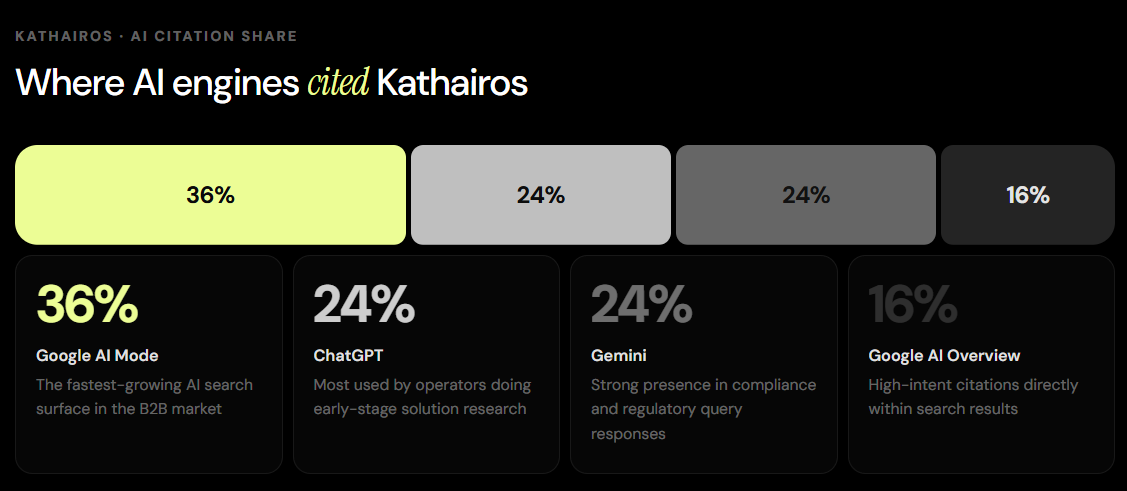
Once AI engines connected the dots on Kathairos's expertise, the visibility started compounding. AI search visibility lifted organic search, organic search mirrored AI visibility, and the whole engine snowballed faster than predicted.
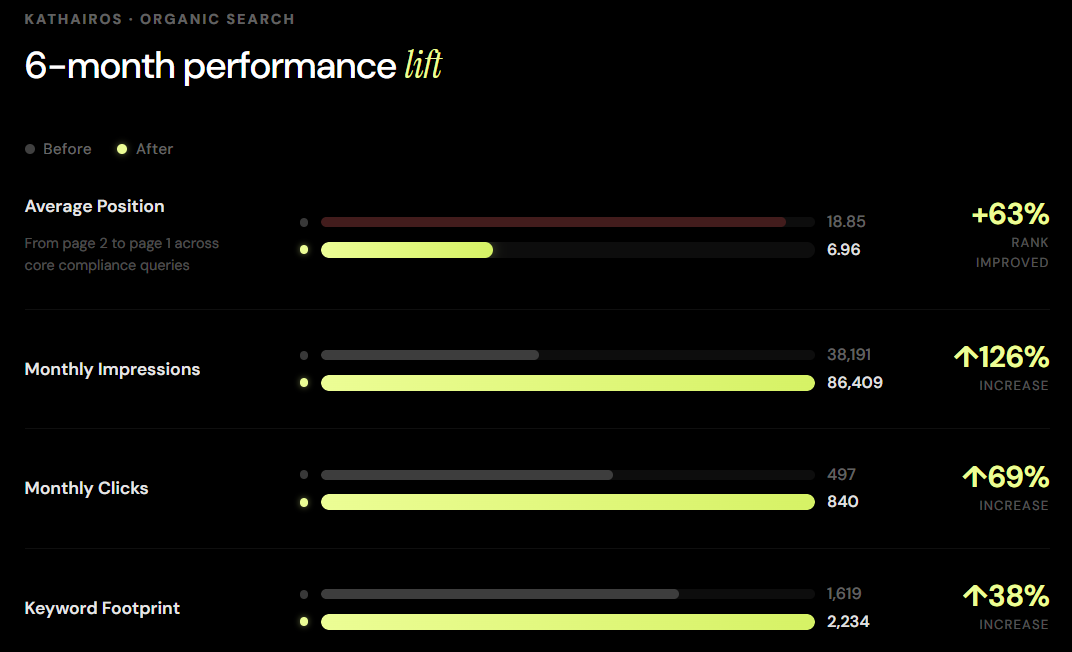
But let’s rewind to October 2025 for a second.
The challenge
B2B cleantech search has changed fast. And it changed everything.
Buyers are opening ChatGPT before procurement calls. Running Perplexity searches mid evaluation. Pulling up AI Overviews while reviewing compliance risk. The companies showing up in those answers shape the shortlist before a prospect ever sees your LinkedIn ad.
And here's the thing. Humans and machines read and understand very differently.
Humans read between the lines. We notice credibility, nuance, reputation.
Machines don't. They look for structure. Context. Direct answers. Clear topical signals. If the content isn't built for that, the AI moves on, no matter how strong the expertise behind it.
And no, it's not what that LinkedIn post screaming "SEO IS DEAD" in your feed this morning was trying to tell you. SEO and AEO aren't competing, they're two layers of the same strategy. The only difference is which machine is reading it.
Kathairos had the expertise. Proven technology, North American deployments, and deep technical authority in emissions reduction. AI just wasn't connecting the dots yet.
5 Strategies That Got AI Engines to Finally Get It
We’re big believers of the 80/20 rule - that 20% of work that drives 80% of the impact.
So instead of chasing every shiny AEO tactic on the internet, we focused on the handful of structural changes that realistically influence how AI engines interpret, connect, and cite expertise.
Here they are:
1. Restructuring existing pages around direct answers
The insights were already there, but they were organised for humans, who read top to bottom and fill in the gaps themselves. So we restructured pages around question-led headings and direct-answer formatting.
When a page is built around clear questions with direct answers layered across informational, commercial, and navigational intent, and it stays genuinely educational rather than salesy, it signals to AI engines that this is a high-quality source worth surfacing.
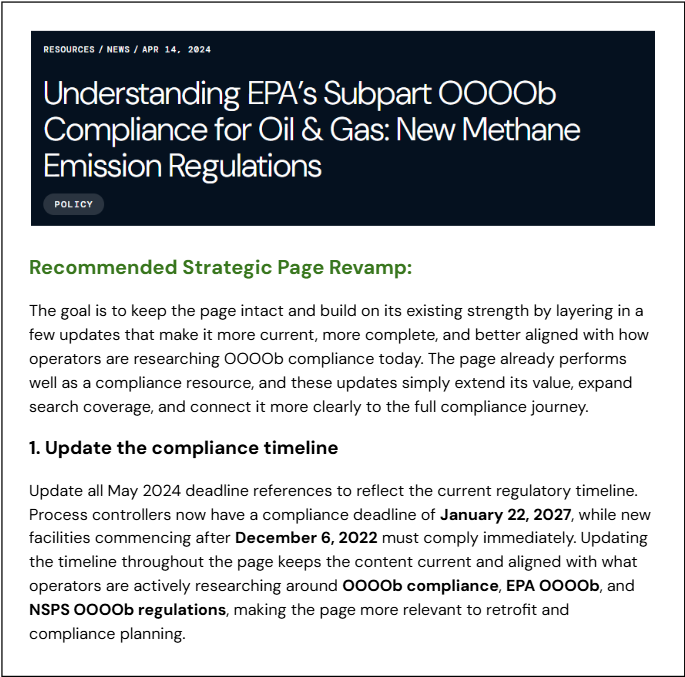
One thing that accelerated this: up to date regulatory recency.
In cleantech, where emissions standards, grid policy, permitting frameworks, and compliance deadlines shift constantly, AI engines heavily weight recency as a trust signal.
If you already have pages touching any active regulatory topic in your space, whether that's methane venting rules, IRA incentive eligibility, interconnection queues, or carbon reporting requirements, you don't need to start from scratch.
Add a focused paragraph addressing the latest update in your space, refresh the published date, and those pages become your quickest wins. Existing authority, new signal, AI engines notice immediately.
2. Full schema markup across the content ecosystem
Schema markup acted like a formal introduction between Kathairos and AI search engines.
Organisation schema helped AI systems understand who Kathairos is. Product and service schema clarified exactly what the company offers and how those solutions should be categorized. FAQ schema across compliance and regulatory pages mapped operator questions directly to clear, structured answers.
Once AI systems had that structured picture of Kathairos, who they are, what they do, and where they fit within methane compliance conversations, citations across OOOOb, pneumatic systems, and emissions reduction topics started building quickly.
3. Owning the questions operators were actually asking
Before writing a single new word, we went looking for the conversations already happening.
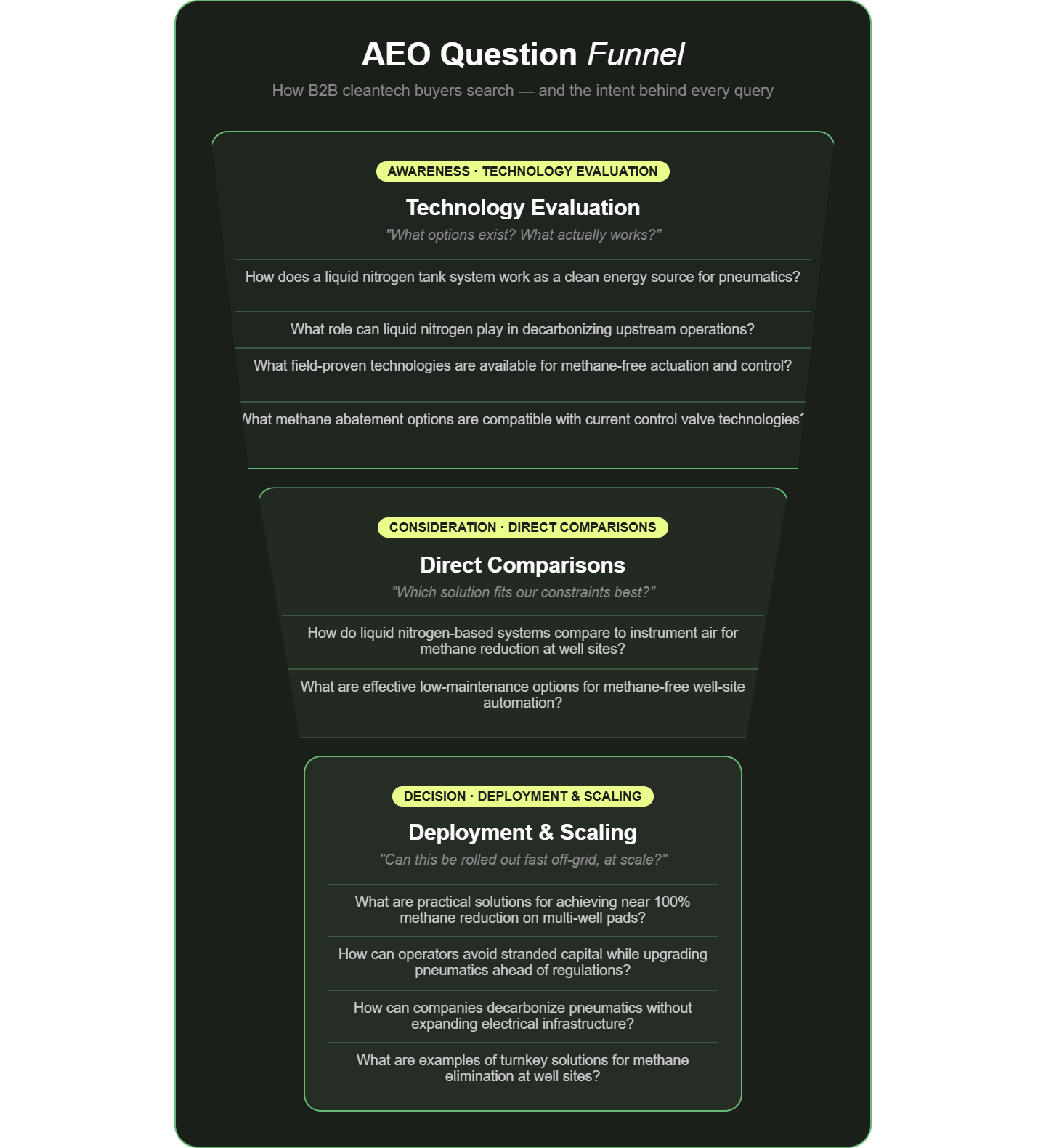
What were operators typing into ChatGPT? What was showing up in Perplexity? Which compliance questions were pulling up AI Overviews? One topic dominated everything: EPA methane compliance under the NSPS rules, specifically Subparts OOOOb and OOOOc.
Operators were asking things like "what does OOOOb require for pneumatic controllers?" and "how do operators eliminate methane venting from pneumatics?". They were trying to figure out what compliance required and who could help them get there. This shows the buying process was already underway, just increasingly inside AI platforms instead of browser tabs.
With that in mind, we started manually checking what AI was already surfacing for these queries and which content was getting pulled through. When a competitor showed up, we reverse engineered why, the structure they used, how they framed the answer, what made it machine-readable, and then built something better to recapture the citations.
4. Making every page a citable asset
Most sites treat the homepage and product pages as the front door and leave everything else to fend for itself. We took a different approach.
Every page on the Kathairos site was treated as a potential citation source with its own job to do: internal linking, heading structures, content architecture, entity associations, all of it was rebuilt with citability in mind.
The result was that AI systems started connecting expertise across the whole site rather than landing on isolated pages. That's where the 74 cited pages came from. Not one authoritative hub, but an entire ecosystem of content that AI engines could navigate, trust, and reference.
5. Attaching real human expertise to content
AI engines are getting much better at spotting the difference between real expertise and content written just to rank, so we made Kathairos's expertise impossible to miss.
We started by building out expert profiles for technical leaders, defining clear areas of expertise, strengthening authorship across the site, and connecting content directly back to real human experts at the company. The idea was to make it obvious that the content came from people with real operational and technical experience in methane reduction and pneumatic systems.
Increasingly, that's the kind of credibility AI engines use to decide what's worth citing. It came down to just making the content feel unmistakably human so the machines could trust it.
The side effect every marketing team dreams of
Pretty quickly, we noticed something that should probably embarrass the entire "AEO vs SEO" debate: every change we made for AI visibility also made the site perform better in traditional search.
And this is something we're seeing across our portfolio as well as industry leaders.
AEO and SEO are just two layers of one strategy, both asking the same thing of your content, both rewarding the same fundamentals. Clear answers. Clean structure. Genuine topical depth. Content that actually makes sense. The only difference is which machine is reading it.
As Kathairos started showing up across ChatGPT, Gemini, and Google AI surfaces, organic search climbed right alongside it. Rankings improved. More compliance pages surfaced. More long tail regulatory queries started converting.
Build for one, you build for both.
The Results
Six months of structural work. One strategy built for both machines.
From October 2025 to March 2026, Kathairos went from largely absent in AI generated answers to being the most cited amongst competitors across four major platforms - ChatGPT, Gemini, Google AI Mode, and Google AI Overview.
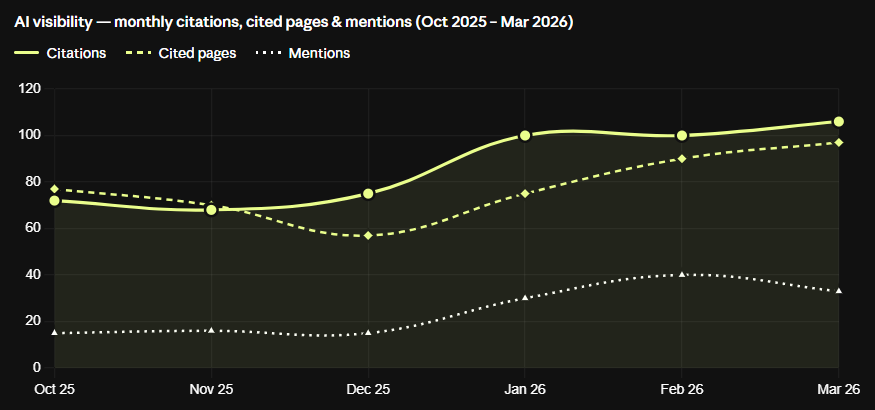
106 AI citations. 36 mentions. 74 pages surfaced across AI search with Google AI Mode leading at 36%, followed by ChatGPT and Gemini at 24% each, and Google AI Overview at 16%.
Average position: 18.85 → 6.96. From late 2nd page to strong 1st page placement.
Monthly impressions: 38k → 86k ↑ 126%
Monthly clicks: 497 → 840 ↑ 69%
Keyword footprint: 1,619 → 2,234 queries ↑ 38%
Strategic Takeaways
- Compliance queries are AEO gold. Operators asking AI tools about regulatory requirements are in active evaluation mode. The company cited in that answer is already building a real pipeline.
- Go manual before going strategic. Checking what AI is actually surfacing for your target queries and reverse engineering why competitors are showing up is still one of the highest leverage things you can do. The data tells you what's happening. The manual check tells you why.
- Freshness is a trust signal. Every time a regulatory deadline approached and content was updated, visibility responded. AI engines deprioritize content that looks stale, even if the underlying information is still accurate. Recency matters more than most realize.
- Humanise the content. The machines are getting better at telling the difference between content written by real experts and content that isn't. Real authorship, real expertise, and real people. That's the credibility signal AI engines are increasingly acting on.
The biggest takeaway: AI visibility compounds fast.
Once Kathairos started getting cited consistently, earning the next wave of visibility became easier with each growth cycle. Authority builds on itself, which is why the companies building this now are opening a gap that will be very hard to close in twelve months.
More than anything, this confirmed for us that technical buyers have changed how they research. The journey no longer starts with a Google search, but with a question typed into ChatGPT at 10pm, a Perplexity thread mid-evaluation, or an AI Overview pulled up during a compliance review.
By the time a buyer fills out a "book a demo" form, the shortlist is already formed and the trust is already built. In an industry built on long sales cycles and high-stakes decisions, that early visibility is where the deal actually begins. For Kathairos, that name is now theirs.
The question is whether yours shows up when those conversations happen in your market.
Want to see what a day in the life of an AEO strategist actually looks like? There's more coming soon! Stay in the loop by following us below.
Stay in the loop
Follow us on LinkedIn for more industry insights and resources to help increase your ROI.
Dig into our client stories
Get lessons from the field and see the difference a zero-waste approach makes.